 shield
Crypto Payments for Freelancers: Get Paid by Overseas Clients Without Losing 5-8%
Freelancers who bill clients abroad lose money before they ever see it: a cross-border surcharge, a currency-conversion spread, and a multi-day hold before the balance is actually yours. Crypto payments for freelancers solve the specific version of this problem that PayPal, wire transfer, and Payoneer all share: a middleman balance sits between the client’s payment and your bank account, and that middleman takes a cut and reserves the right to freeze it. Shieldz removes the middleman balance. The client pays on-chain, the funds land in a wallet only you control, and there is no platform fee for it to happen.
This sits next to the crypto invoice generator guide and how to accept crypto payments. Use those for the mechanics of building an invoice link. Use this post for the freelancer-specific case: getting paid reliably by clients in other countries, milestone by milestone, without giving up a slice to every rail in between.
Why international freelance payouts are expensive by design
PayPal adds a cross-border surcharge on top of its normal invoicing rate, then a currency-conversion markup on anything that needs converting. On a $1,000 invoice from an overseas client, the processing fee plus FX markup commonly runs $80 to $90, close to a full extra day of billable work handed over for moving money. Payoneer and wire transfers are cheaper but still charge a percentage and, for wires, a flat fee plus a multi-day hold. None of these actually make the payment faster. A wire can take 2 to 5 business days to clear, and a PayPal balance can be reviewed or limited if the pattern looks “unusual”, which is a real risk when your income is a handful of large payments from clients your processor has never seen before.
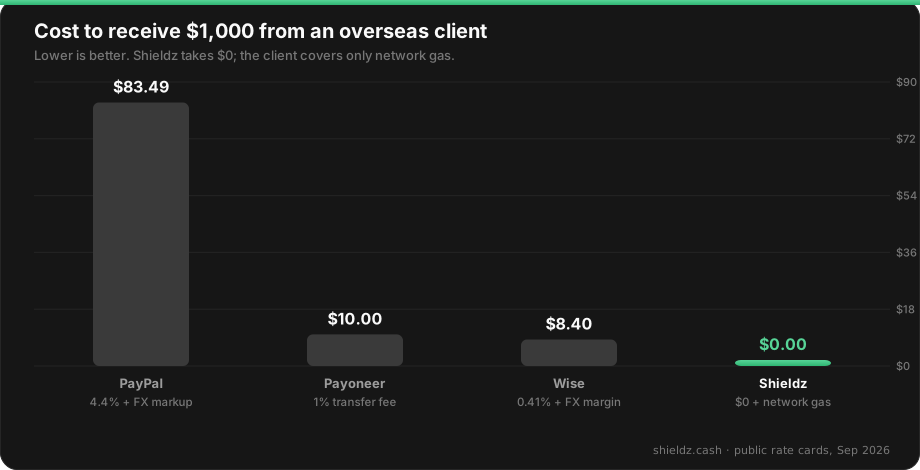
A crypto invoice skips both problems at once. There is no balance to freeze because Shieldz never holds one, and settlement is a confirmed on-chain transaction, typically minutes, not business days. See non-custodial crypto payment gateway for what “never holds a balance” actually means cryptographically, and /verify if you want to check the claim yourself instead of taking it on faith.
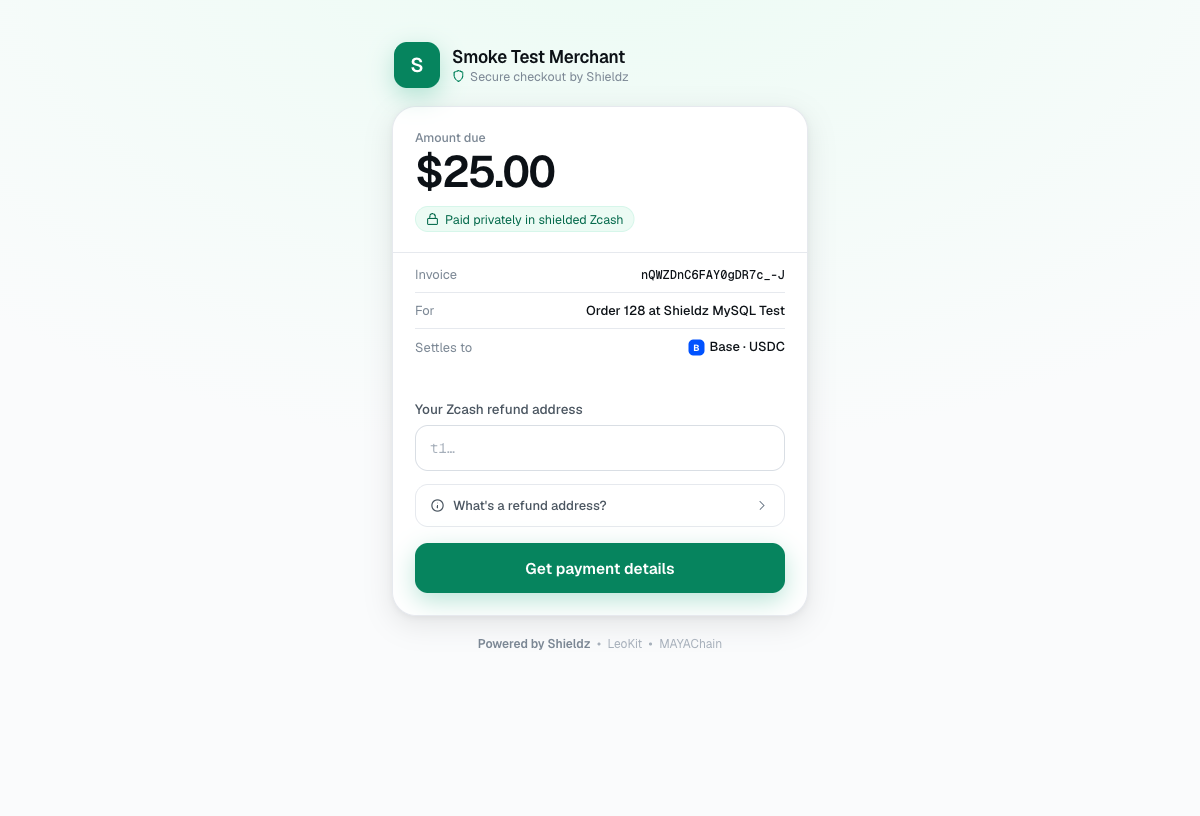
Step-by-step: invoice a client and get paid
1. Create a merchant and register a receive address
Sign up at the dashboard with a wallet, Google, or Telegram account. No KYC to start. Register the public address (or a Zcash viewing key, if you want the shielded-privacy option) for the chain you want paid on. USDC or USDT on Base keeps invoice amounts stable and gas near zero. See accept stablecoin payments.
2. Generate the invoice for this milestone or deliverable
Use the dashboard for a one-off amount, or the payment link tool if you send the same client a link every sprint. Set the amount in USD, add a memo the client will recognize on their end (“Invoice #14, Sept sprint”), and send the link by email or in your project tracker. Full API version, if you bill from your own invoicing tool:
curl https://shieldz.cash/api/v1/invoices \
  -H "Authorization: Bearer sk_live_…" \
  -H "Content-Type: application/json" \
  -d '{
    "amount_usd_cents": 250000,
    "memo": "Invoice #14, September sprint",
    "idempotency_key": "client_acme_2026_09_sprint",
    "metadata": { "client": "acme", "period": "2026-09" }
  }'
Amount bounds today: $1.00 to $100,000.00 per invoice. Default expiry is 30 minutes (45 minutes when ZEC is the settlement asset), long enough for a client to open a wallet app without the quote going stale.
3. The client pays whatever coin they actually hold
Your client does not need to hold the exact asset you settle in. If they pay a different supported coin, swap-settle routes the payment through NEAR, Chainflip, or Relay (the LeoKit aggregator) and you still receive the asset you configured. Shieldz takes no affiliate cut on that swap; the client only sees the standard network gas and the swap’s own spread. Read the trust tradeoff of “pay any coin” if you want the mechanics of why this is safe for you as the recipient.
4. Confirm and reconcile
If you build your own invoicing on top of the API, Shieldz POSTs invoice.paid to your webhook with an X-Shieldz-Signature header (HMAC-SHA256, verify the raw body). Match it to the invoice ID and client metadata so a retried delivery never double-books a payment. Full signature-verification snippet: crypto payment API quickstart. If you are just using the dashboard, the invoice simply flips to “paid” and you see the transaction hash.
What this does not solve
- Shieldz does not convert your crypto to fiat or deposit into a bank account. If your accountant needs a fiat ledger, that is a separate step you handle yourself (an exchange off-ramp, for instance). See crypto payment gateways and fiat settlement for what that landscape looks like.
- The client still pays network gas, and the swap route (when used) has its own spread. Neither is a Shieldz fee, but do not market the invoice as literally free to send.
- NEAR and SOL are not live source chains for swap-settle right now. If a client only holds one of those, have them bridge or swap to a supported asset first.
FAQ
Do I need a business entity or KYC to invoice a client? No. Shieldz signup is wallet, Google, or Telegram, and there is no KYC gate to start invoicing. See do crypto payment gateways require KYC.
Can my client pay from an exchange or a self-custody wallet? Either. The hosted checkout shows a QR code and a wallet deep-link, and works the same whether the client copies an address from an exchange withdrawal screen or taps through from MetaMask, Coinbase Wallet, Trust, or Rainbow.
What happens if the client pays late and the quote expired? The invoice just stays unpaid; generate a fresh one. There is no on-chain mandate that charges them automatically later, which is also why there is no chargeback risk once a payment actually confirms.
Is this safer than PayPal for a large one-off payment? It removes the specific risk PayPal freelancers hit most: a processor freezing or reviewing a balance because a payment pattern looks unusual. Shieldz never holds a balance to freeze; funds land directly at your registered address. It does not remove ordinary client-side risk (a client who simply does not pay), which no payment rail solves.
Start
Create a merchant and send your next invoice as a link, or wire it into your own tools with the API reference. If most of your work comes through a marketplace-style flow instead of direct billing, crypto payments for AI agents and the MCP path cover the automated end of the same rails.
