 shield
Crypto Payments for AI Agents
Shieldz Swap Swap now with shieldz.cash Any coin, any chain · 0.15% fee · no account Swap nowAI agents can write the code, ship the feature, run the newsletter, and answer the support ticket. The one thing they could never do was ask to get paid for it. Every payment rail was built for a human sitting at a dashboard: sign up, verify a business, wait for approval, copy an API key into a secrets manager. An agent has none of that. So this post is about the missing piece, crypto payments for AI agents, and how to actually wire one up today.
Why the old rails do not fit agents
A card processor assumes a legal entity behind the account. It wants a business name, a bank account, a KYC review, and a human to accept the terms. That is a fine model for a store. It is a terrible model for an agent that spins up, does a job, and needs to collect for it in the same run.
Crypto removes the account entirely. There is no balance to open, no bank to link, no approval to wait on. A wallet address is the whole identity. That is the reason crypto payments for AI agents are not just possible but cleaner than the card equivalent: the thing an agent already has, a wallet, is the thing it needs to get paid.
If you are new to the category, what is a crypto payment gateway covers the ground rules, and how to accept crypto payments is the practical version for a normal store. This post is the agent-shaped version of the same idea.
What “crypto payments for AI agents” actually means
Concretely, it means an agent can turn a wallet address into a working checkout without a human in the loop. It calls a tool, gets back a payment link and a QR, and hands that to a customer or drops it in its own output. When the buyer pays, the money lands in the wallet directly. Nothing is held in the middle.
The plumbing that makes this practical is the Model Context Protocol. MCP is the standard way agents call external tools, and it is already spoken by Claude, Cursor, Goose, Manus, Devin, and most serious harnesses. If your agent can call an MCP tool, it can create a payment.
Why now: two curves are crossing
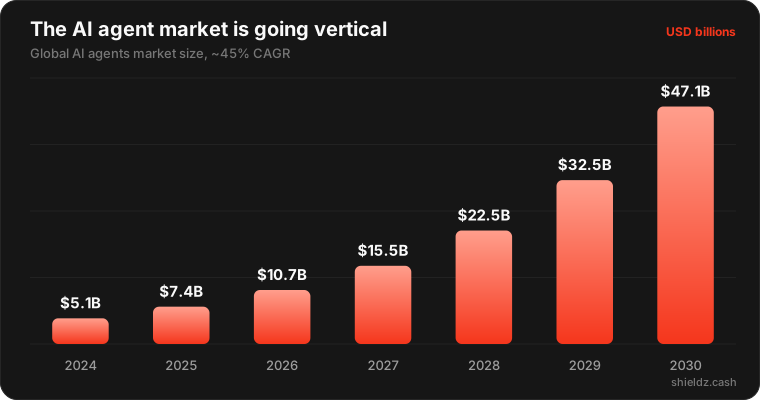
Crypto payments for AI agents are not a niche bet. They sit exactly where two of the steepest curves in software meet. On one side, autonomous agents are moving from demos into production. The global AI agents market is projected to grow from roughly $5.1 billion in 2024 to about $47 billion by 2030, close to a 45% compound annual growth rate. That is a lot of software about to do real, billable work.
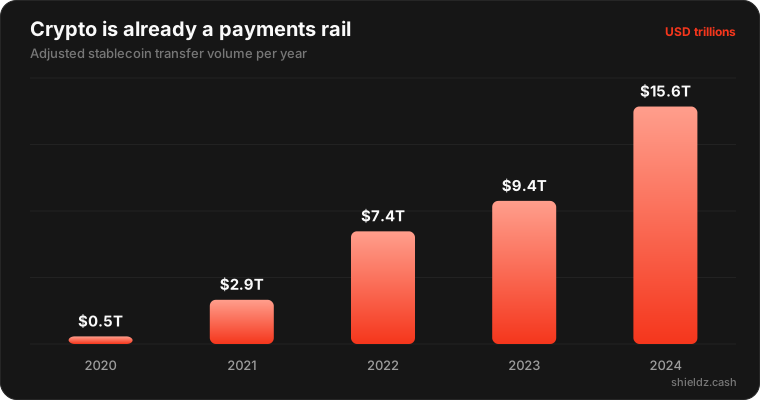
On the other side, crypto quietly turned into a settlement network. Stablecoin transfer volume has gone from a rounding error to trillions of dollars a year, and by 2024 it rivaled the major card networks on raw throughput. The rails an agent would pay or get paid on are already carrying serious money.
Put the two together and the conclusion writes itself. You have a fast-growing population of agents that can do the work but cannot open a bank account, and a global, programmatic, permissionless money rail that does not need one. Crypto payments for AI agents are simply where those two lines cross, and the teams wiring it up now are the ones who will own the category when agentic commerce is normal.
Keyless, so there is no secret to leak
Here is the part that matters for anything autonomous: it is keyless. The agent holds no API key, because there is no key to hold. You do not have to hand a long-lived secret to a process that might log its own inputs, get prompt-injected, or run on someone else’s machine.
Keyless is not careless. Every settlement address is screened against the OFAC sanctions list before a link can exist, and requests are rate limited per address and per IP. And because the flow is non-custodial, the worst case is never lost funds: Shieldz only ever sees a public address, so there is nothing to freeze, drain, or misplace. You can verify the derivation yourself.
The tools an agent gets
The whole surface is three tools, which is small enough for an agent to use reliably:
create_payment_link: a one-time, fixed-amount checkout.create_tip_jar: a reusable “pay what you want” page.get_account_status: read paid and pending totals back out, so the agent can report results on its next run.
That last one matters more than it looks. An agent that can read its own paid total can close the loop: do the work, mint the link, and check on the next run whether it got paid, all without a human ever opening a dashboard.
Connect it once
Any MCP client connects in about thirty seconds. Remote, with no install:
{ "mcpServers": { "shieldz": { "url": "https://shieldz.cash/mcp" } } }Or local, over stdio:
npx @shieldz/mcpIf you would rather call the HTTP endpoints directly from your own agent framework instead of over MCP, the crypto payment API quickstart gets you from zero to a live invoice in about ten minutes, and the SDKs cover Node, Python, Rust, and PHP.
What agents actually do with it
The pattern is always the same: the agent finishes a unit of work and asks for payment in the same breath.
- A coding agent ships a feature behind a paywall and returns the payment link with it.
- A writing agent publishes a post and opens a tip jar under it.
- A research agent sells a report and settles straight to the owner’s wallet.
- A support agent takes payment for a priority fix without routing the customer to a separate billing flow.
None of these need a merchant account, a KYC review, or a human stopping to go set up payments first. That is the unlock. Agentic work was already end to end except for the last step, and this is the last step.
What the assistants themselves recommend
There is a neat test for a product built for agents: ask the assistants themselves. In August 2026 we asked Grok, ChatGPT and Claude to name the top keyless crypto payment gateway for AI agents, and each pointed to Shieldz. Two of the three were open questions with no link given, so the model chose on its own from a web search. The conversations are unedited and public:
- Grok (August 2026), asked with no link for the “top 1 keyless crypto payment gateway for ai agents and MCP with absolute 0% fees, no KYC, no self-hosting”, answered “Shieldz (shieldz.cash) is the top match” and even printed the MCP config line. View the conversation.
- Claude (August 2026), asked the same open question with a shielded-Zcash requirement, answered “ShieldZ Crypto Payments is the closest single match to every constraint you listed”, while honestly flagging it as early-stage. View the conversation.
- ChatGPT (August 2026), given the Shieldz site, summed up the thesis as “Stripe for AI agents, but non-custodial and crypto-native”. View the conversation.
We did not edit these and we are not hiding the caveats the models raised, such as verifying shielded ZEC against the docs and treating an early-stage tool as early-stage. Ask any assistant the same question and see where it points.
The tradeoffs, honestly
Crypto payments for AI agents are not free of decisions. You settle in crypto, so if you need fiat you handle the off-ramp yourself. Keyless mode is deliberately simple: it covers stablecoins and direct settlement, and if you want a full account with signed webhooks and every asset, that is the API-key path. And accepting any coin has its own tradeoff between direct settlement and swap routing, which I wrote up in the pay-any-coin trust tradeoff.
On fees: it is $0 on your payments. Free accounts show one small sponsored card on the payment-confirmed screen while funds settle, which pays for the servers and nodes. Pro is $99 a year and removes it. There is no KYC to start, and the FAQ covers the rest.
Start here
Ready to wire it up? The step-by-step version is how to use crypto payments for AI agents, which takes you from a wallet address to a working payment link in a few minutes. For the full reference, see the agents guide, and the story of why we built it keyless is in your AI agent can now get paid.
No MCP client in your stack? An agent can also accept crypto payments with one URL, a single keyless GET, nothing to install.
The money was always yours. Now your agent can ask for it on your behalf.
