 shield
Accept stablecoin payments: USDC, USDT, PYUSD and 20+ more
Shieldz Swap Swap now with shieldz.cash Any coin, any chain · 0.15% fee · no account Swap nowTo accept stablecoin payments is to get paid in dollars that live on a blockchain: a customer sends you USDC or USDT, it confirms in seconds, and it is final. No 3% card fee, no chargeback window, no payout that lands next week. For a business, that is the whole pitch of crypto without the price swings, because a stablecoin is pegged one to one to the dollar (or the euro, or gold).
This guide covers how to accept stablecoin payments the non-custodial way with Shieldz: 20+ stablecoins across the major chains, a $0 platform fee, and settlement straight to your own wallet. It sits in the same cluster as how to accept crypto payments and what a crypto payment gateway is; start there if you want the wider picture first. If you also want to take BTC and ETH alongside stablecoins, see pay with BTC, ETH, USDT or USDC.
Why accept stablecoin payments
Card rails were built for a different era and priced like it. On a single $100 sale, PayPal keeps about $3.98 and a Stripe card charge about $3.20. A custodial crypto processor still skims roughly 1%. A stablecoin payment on a low-fee chain like Base costs the buyer around a cent of network gas and charges you nothing.
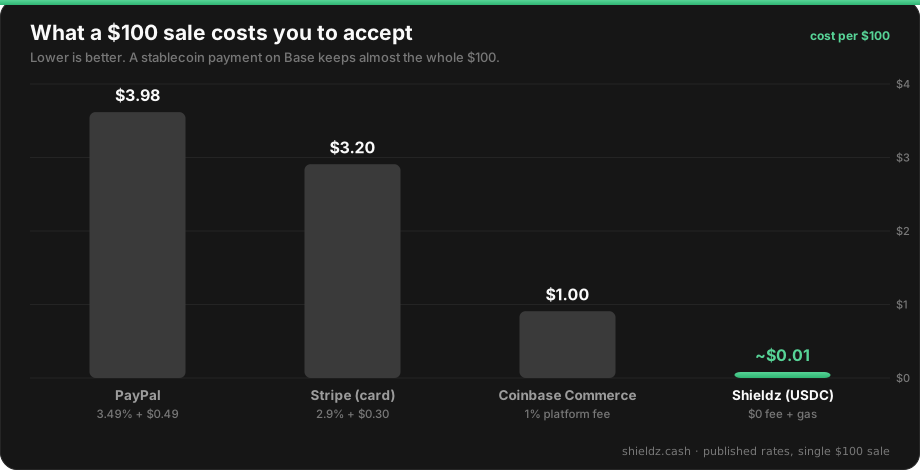
The fee is only the first reason. Stablecoin payments are also:
- Final. An on-chain payment cannot be reversed. There is no chargeback fraud and no “item not received” dispute six weeks later.
- Instant. The money lands in your wallet as the transaction confirms, not on a processor’s payout schedule.
- Global. A customer in any country pays the same way, with no card-network borders or currency conversion desk in the middle.
- Yours. With a non-custodial gateway, the funds are never held by anyone else, so there is no account to freeze and no balance to release.
Which stablecoins can you accept
The two that carry most volume are USDC and USDT, and you can accept USDC or accept USDT across Base, Arbitrum, Optimism, Polygon and Ethereum, plus USDT on Tron and both on Solana. Beyond the big two, Shieldz settles a wide bench of brand-name dollar stablecoins:
- PayPal USD (PYUSD), Sky Dollar (USDS), Ripple USD (RLUSD) and First Digital USD (FDUSD)
- Pax Dollar (USDP), Gemini Dollar (GUSD), Dai (DAI), Curve USD (crvUSD), Aave GHO and Frax (FRAX)
It is not only dollars. You can take the euro stablecoin EURC (Circle’s MiCA-compliant euro coin) and even PAX Gold (PAXG), a token backed one to one by physical gold, if you want to price in something other than USD. See the full list on supported coins.
You do not have to make the customer hold the exact coin you want, either. Shieldz can let a buyer pay in almost any coin and settle you in the single stablecoin you chose, routing the swap under the hood. That convenience has a tradeoff worth understanding, which we cover in pay any coin: the trust tradeoff.
How to accept stablecoin payments in three steps
The flow is the same whether you sell software, services, or physical goods.
- Point Shieldz at your wallet. You give it a settlement address, the wallet where you want the money to land. That is a public key, so Shieldz can watch for payments but can never spend them.
- Create a checkout. Spin up a payment link in seconds, or call the API to create an invoice. Either way the customer gets a hosted pay page with the amount, an address, and a QR code.
- Get paid and get notified. The customer sends the stablecoin, it settles directly to your wallet, and a signed webhook tells your app the instant it confirms, so fulfilment is automatic.
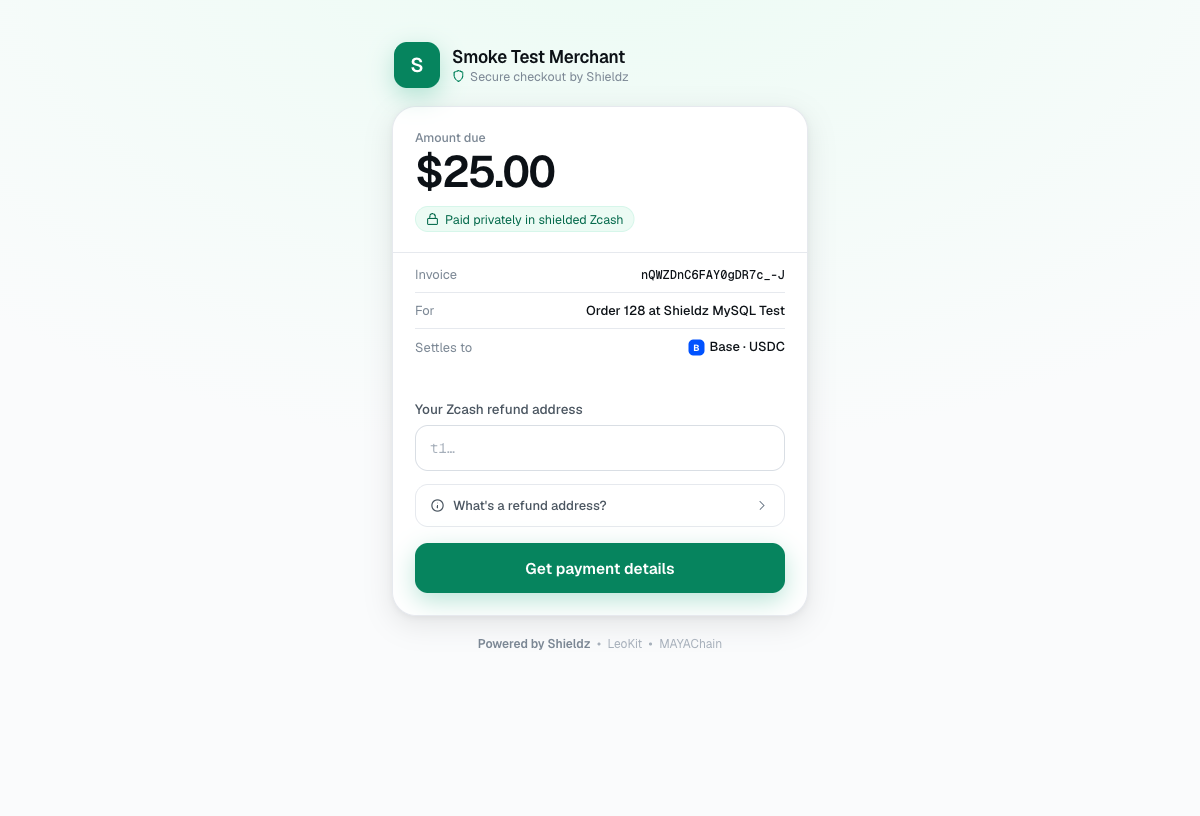
Developers can wire this in with a few API calls; see the crypto payment API quickstart and the API docs. Running a store instead of code? The same engine powers the WooCommerce plugin.
Non-custodial by default
The reason a stablecoin payment can be final, instant, and free is that no middleman sits in the value flow. Shieldz only ever holds a public key, so it settles every payment to the wallet you control and can never freeze or seize a balance, because there is no balance. There is no KYC to start, and the key-derivation code is open source, so you can verify the non-custodial claim yourself. Pricing is simple: $0 platform fee, you pay only the coin’s network gas.
FAQ
What does it cost to accept stablecoin payments? With Shieldz, a $0 platform fee. The buyer pays their coin’s network gas (about a cent on a chain like Base), and you keep the rest of the sale.
Which stablecoins can I accept? USDC and USDT across Base, Arbitrum, Optimism, Polygon, Ethereum, Tron and Solana, plus PYUSD, USDS, RLUSD, FDUSD, USDP, GUSD, DAI, crvUSD, GHO and FRAX, the euro coin EURC, and gold-backed PAXG.
Do stablecoin payments have chargebacks? No. An on-chain payment is final once confirmed, which removes chargeback fraud entirely. The other side of that coin is that there is no built-in buyer-protection reversal, so treat a confirmed payment as settled.
Do I need KYC or an account to start? No KYC to start. Because Shieldz never holds funds, there is no balance to verify. You can create a keyless payment link with just a wallet address.
Where does the money go? Straight to the wallet address you set. Shieldz is non-custodial, so funds never pass through its hands.
Start accepting stablecoins
Point Shieldz at a wallet and you can accept stablecoin payments today, with $0 platform fees and no KYC. Create a payment link, read the API quickstart, or see the full crypto payment gateway overview. If you are weighing options, here are the best free crypto payment gateways in 2026. Just want the biggest one? See how to accept USDT payments.
