 shield
Why Accept Crypto Payments, and What to Watch Out For
Why accept crypto payments? Because for a growing share of the internet, crypto is simply the money people have. Hundreds of millions of people hold a wallet, and in large parts of Asia, Africa and Latin America a stablecoin balance is more usable than a bank account. Every checkout that only takes cards quietly turns those buyers away.
The honest version of the question has two halves, though. There are real, measurable reasons to accept crypto, and there are real traps that catch merchants who pick the wrong setup. This guide covers both: the four reasons to do it, and the four things to watch out for before you choose a provider. The short answer to the second half is one word, custody, and we will get to it.
Reason 1: reach
A card checkout depends on a long chain of permissions: the buyer’s bank, the card network, your acquirer, your processor’s risk team. Any link can say no, and for cross-border sales they often do. A crypto payment depends on none of them. Anyone with a wallet can pay you from any country, and the payment either confirms on-chain or it does not. There is no “your card was declined” for reasons neither of you can see.
That matters most if you sell digital goods, services or software to a global audience. The buyer in Argentina, Nigeria or Vietnam who cannot complete a Stripe checkout can usually complete a USDT one. We wrote up the mechanics in how to accept crypto payments.
Reason 2: cost
Card rails take a percentage plus a flat fee of every sale, and it adds up fast. On a $100 sale, PayPal’s published rate is 3.49% plus $0.49, so $3.98 gone. Stripe takes 2.9% plus $0.30. Even crypto processors like Coinbase Commerce take 1%. A non-custodial gateway with a $0 platform fee takes nothing; the buyer pays about a cent of network gas on a low-fee chain like Base.
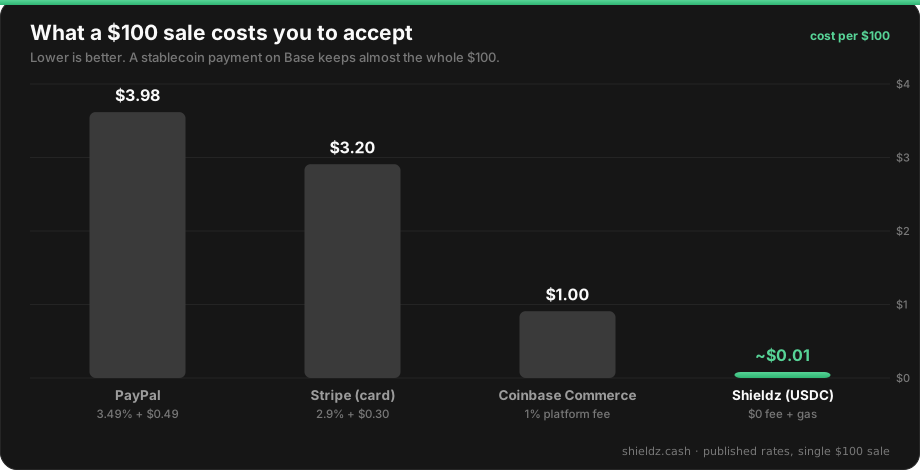
Three to four percent sounds small until you translate it into margin. If your net margin is 20%, the card fee alone is a fifth of your profit on every sale.
Reason 3: finality
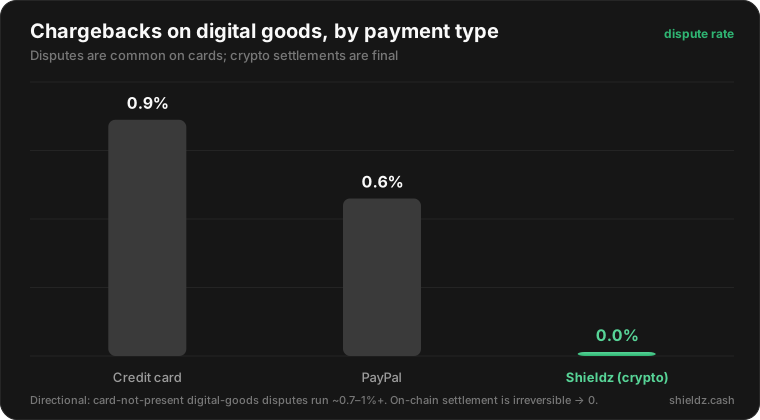
Card payments can be reversed for months after the sale. For digital goods that is an open wound: the buyer downloads the file, disputes the charge, and you lose the product, the revenue and a dispute fee on top. Crypto has no chargeback mechanism. Once a payment confirms on-chain it is final, and refunds happen only when you choose to send one.
Reason 4: speed
A stablecoin payment confirms in seconds to minutes and the money is spendable immediately. Compare that to card settlement schedules, rolling reserves, and the classic “payout on hold pending review” email. When settlement is straight to your own wallet there is no payout step at all, because the payment and the payout are the same transaction.
Watch out 1: custody
This is the trap that matters most. Most crypto processors are custodial: the buyer’s payment lands in the company’s wallet first, and you receive it later, under their terms, after their identity checks. That reintroduces everything you were trying to escape: an intermediary who can freeze funds, delay payouts or close your account. A non-custodial crypto payment gateway settles every payment straight to an address you control, and a self-hosted gateway removes the provider entirely. Shieldz never holds the funds and never sees a private key, and you can verify that yourself.
Watch out 2: hidden fees
“1% only” pricing often hides the rest of the bill: withdrawal fees, conversion spreads, monthly minimums, or float earned on your money while it sits in the processor’s account. Ask for the full math on a single $100 sale, from buyer to your wallet. With Shieldz the answer is simple: $0 platform fee, and the buyer pays their own network gas. See pricing.
Watch out 3: forced KYC
If accepting a payment requires incorporation documents and a week of review, the reach argument dies on arrival. Freelancers, creators and merchants in unsupported countries get filtered out exactly like their buyers do. It does not have to work that way: accepting crypto without KYC is possible when the provider never touches the money and therefore has nothing to hold.
Watch out 4: volatility and coin sprawl
You quoted $100; you want $100 next week too. The fix is settlement choice: let buyers pay in BTC, ETH or anything else they hold, and settle in a stablecoin like USDC in your own wallet. You take the reach without taking the price risk, and without ending up holding a grab-bag of coins. That is exactly how accepting stablecoin payments works, and the Bitcoin guide shows the same trade for BTC specifically.
FAQ
Is accepting crypto payments worth it for a small business? Yes, precisely because the fixed costs are zero. No terminal, no contract, no monthly fee. You create a payment link and share it; if nobody pays with crypto, it cost you nothing.
Do I have to hold crypto to accept it? No. Buyers pay in the coin they hold and you settle in a stablecoin like USDC, so the amount you quoted is the amount you keep.
What about chargebacks and fraud? Crypto payments are final once confirmed, so chargeback fraud disappears. Refunds still work; they are just a payment you choose to send back.
What is the biggest mistake to avoid? Choosing a custodial processor. If the provider holds your money before you do, fees, freezes and KYC all follow from that one design choice.
The bottom line
Accept crypto for the reach, the near-zero cost, the finality and the speed. Avoid the traps by refusing custody, demanding transparent fees, skipping forced KYC and settling in a stablecoin. Create a checkout in a minute with the payment link generator, or start with the practical walkthrough in how to accept crypto payments.
