 shield
How to Accept Crypto Payments Without KYC (2026)
Can you accept crypto payments without KYC? Yes. With a non-custodial gateway you need a wallet address and nothing else, no account, no identity verification. Almost every well-known processor asks for KYC because it holds your money first. Remove the middleman that holds funds, and the requirement disappears with it.
This guide explains why most gateways force KYC, why the non-custodial model does not need it, and how to start accepting crypto with no signup. With Shieldz the only thing you provide is a wallet address, and funds settle straight to it with a $0 platform fee.
Why most gateways require KYC
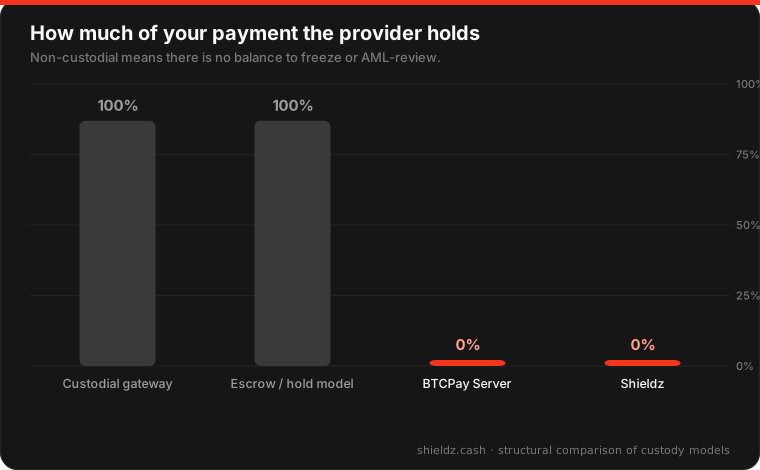
The reason is custody. A custodial payment gateway collects the customer’s money into its own account first, then pays you out later. The moment it holds someone else’s funds, it becomes a regulated financial intermediary, and that triggers identity verification (KYC), account approval, and often a review process. So KYC is not a property of the product, it is a consequence of the custodial model.
Why non-custodial removes the KYC requirement
In a non-custodial gateway the money goes straight to a wallet address you own, on-chain. The gateway only watches the chain and never holds a balance. Because there is nothing to hold, there is no intermediary moving funds on your behalf, and therefore no reason to demand identity verification to get started.
Shieldz is built exactly this way: you give it a public key (an address, an xpub, or a Zcash viewing key), customers pay that address, and Shieldz only watches. It cannot spend, freeze, or seize the funds. You can verify that yourself. For the most private variant, you can even accept shielded Zcash.
How to accept crypto without KYC, step by step
- Have a wallet address. Any EVM wallet starting with
0xworks. You never share a private key. - Create a payment link. Paste your wallet and an amount into the payment link generator. No signup, no forms.
- Share it. The customer pays, and the money lands directly in your wallet.
No account, no verification, no waiting. For the wider setup, see how to accept crypto payments.
No KYC does not mean no compliance
Here is the honest part: no KYC does not mean no checks at all. Every payment address is screened against the OFAC sanctions list, and requests are rate limited. The difference is that we do not collect documents from you, the seller, because we never hold your money. All payments are fully on-chain and auditable. You can screen any address yourself with the OFAC address checker. No KYC is about not holding your funds, not about hiding the transaction.
Who accepts crypto without KYC
This model fits anyone who wants to get paid without handing a company their identity and their revenue: freelancers billing clients abroad, digital sellers, creators taking tips, open-source projects, and merchants in regions where opening a processor account is slow or impossible. If you would rather keep the two addresses unlinked as well, see private crypto payments.
FAQ
Can I really accept crypto without KYC? Yes. With a non-custodial gateway the money goes straight to your wallet and nobody holds it in between, so no verification is needed to start. You only need a wallet address.
Why is KYC mandatory on some gateways? Because they are custodial: they hold your money first, which makes them a financial intermediary and triggers identity verification.
Is it safe without KYC? No documents are collected from the seller, but every payment address is screened against sanctions lists and all transactions are on-chain and auditable.
Where does the money go? Straight to the wallet you control. Shieldz is non-custodial and cannot hold, freeze, or seize the funds.
What does it cost? A $0 platform fee. The buyer pays only the network gas for their transaction.
Start without KYC
With one wallet address and no verification, you can start accepting crypto today. Create a payment link now, see the no-KYC page, or read why a non-custodial crypto payment gateway is the structural reason it works.
