 shield
Private Crypto Payments: How Confidential, Unlinkable Routing Works
Shieldz Swap Swap now with shieldz.cash Any coin, any chain · 0.15% fee · no account Swap nowAlmost every crypto payment is a permanent public record. When a customer pays you in USDC or ETH, anyone can open a block explorer and see their wallet paying your wallet, the exact amount, forever. For a payment rail, that is a strange default: a card payment is not published to the world, but a “crypto payment” usually is. Private crypto payments fix the part that leaks the most, without giving up self-custody.
Shieldz now routes swap-settled payments confidentially. The customer can pay in almost any coin, the conversion to your settlement token runs through a shielded route, and the public link between “this buyer” and “this seller” is broken. This post is an honest walk-through of what that actually shields, what it does not, and how to turn it on. It is a companion to our piece on the pay-any-coin trust tradeoff and on the non-custodial crypto payment gateway model.
What is actually public in a crypto payment
A swap-settled crypto payment has three stages, and only one of them can be made confidential. Being precise about this is the whole point, because a lot of “private crypto” marketing quietly overclaims.
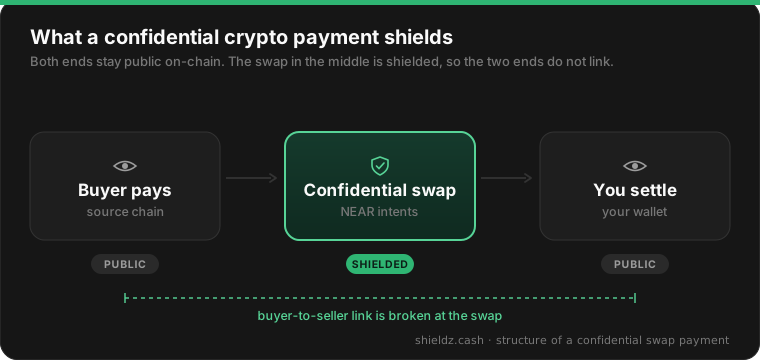
- The buyer’s deposit is public. They send their coin to a deposit address on the source chain. That transfer is a normal, visible on-chain transaction.
- The swap is confidential. The conversion to your settlement token runs through NEAR’s confidential intents. The amounts and the buyer-to-seller pairing are not exposed on a public order book.
- Your settlement is public. The settled token lands in your own wallet as a normal on-chain transfer.
So confidential routing does not hide either end. It hides the connection between them. An observer watching the buyer sees money leave to a deposit address, not “paid merchant X.” An observer watching your wallet sees funds arrive from a solver, not “received from buyer Y.” The chain that would normally join those two facts is shielded.
Who does it protect, honestly
It protects the relationship, and that cuts both ways.
- For the buyer: their wallet is not publicly recorded paying your specific business. Their spending is not linkable to your storefront on-chain.
- For you, the seller: individual payments are not traceable back to specific customers, so your revenue is not a public map of who bought what.
Here is the honest boundary. Confidential routing does not hide the total volume arriving at your settlement address (anyone watching that address still sees funds come in), and it does not hide the buyer’s own outgoing transaction on their chain. It breaks linkability at the swap, which is the single most revealing part. It is unlinkable routing, not total anonymity, and we would rather say that plainly than sell you a promise the chain cannot keep.
How the confidential route works
The confidential leg runs on NEAR’s confidential intents through the NEAR / Chainflip / Relay routing layer Shieldz already uses for pay-any-coin. When a merchant enables confidential mode, the swap quote is requested as a shielded intent, and the deposit inherits that setting, so the conversion itself is not posted to a public order book.
Nothing about the non-custodial model changes. Shieldz never holds the coins or the keys. The buyer’s funds move to the deposit address, the shielded swap settles the token to your own wallet, and Shieldz only ever watches the chain to confirm it landed. You can verify that yourself. There is no platform fee, only the network’s gas. And if you want the fully shielded coin end to end rather than a shielded swap leg, see how to accept Zcash payments.
Two modes: private-when-possible, or private-only
Confidential routing is pair-dependent. Some coins can be shielded today, some cannot yet. So a merchant gets two honest choices in the dashboard, plus off:
| Mode | What it does | Best for |
|---|---|---|
| Off | Standard routing, best rate. | Merchants who do not need privacy. |
| When available | Requests a shielded route per coin, and quietly falls back to the standard route when a pair cannot be shielded. A payment never fails just because privacy was not possible. | Most merchants. Privacy as pure upside, zero risk to completion. |
| Only | Every payment must settle privately, or the coin is not offered. The checkout shows only coins that can actually route confidentially. | Merchants who want a hard privacy guarantee. |
“When available” is the mode we recommend. It treats privacy as a bonus that never costs you a sale: if a coin can be shielded, it is, and if it cannot, the payment still completes on the standard rail. “Only” is stricter, for merchants where a public swap is simply not acceptable.
The buyer sees it too
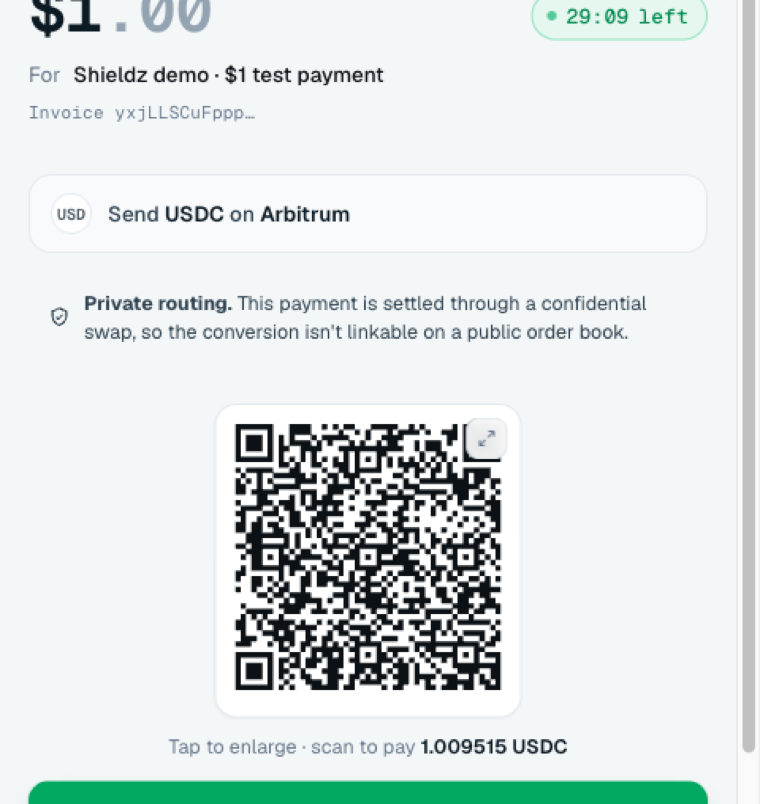
When a payment actually routes privately, the checkout shows a Private routing badge on the deposit screen. It is trust the customer can see, not just a claim in your marketing.
How it compares
| Approach | Unlinks buyer and seller | Custody | Coins accepted | Platform fee |
|---|---|---|---|---|
| Shieldz confidential routing | Yes (shielded swap) | Non-custodial | Pay in almost any coin | $0 (only gas) |
| Shielded Zcash (z-to-z) | Yes (fully encrypted) | Non-custodial | ZEC only | Varies |
| Standard USDC / ETH payment | No (fully public) | Depends | That coin | Varies |
| Custodial "private" processor | Only from outsiders, not the processor | Custodial | Varies | Percentage cut |
If you want the strongest possible on-chain privacy for a single coin, shielded Zcash encrypts the sender, receiver, and amount outright. Confidential routing is the broader tool: it lets a customer pay in almost any coin and still breaks the buyer-to-seller link, settling to your wallet in your chosen token.
An honest note on compliance
Privacy for a legitimate business and its customers is normal, and it is not the same as evading the law. A few honest points, the same ones we make everywhere: Shieldz screens paying addresses against the OFAC sanctions list, so confidential routing does not mean accepting sanctioned funds. Your business still has its own tax, accounting, and record-keeping obligations, which do not change because a rail is private. And, as above, this is unlinkable routing, not absolute anonymity. That is the honest version of “private crypto payments,” and it is the one worth building on.
Start accepting private crypto payments
Turn it on in the dashboard: enable pay-any-coin, then set confidential mode to when available or only. Every eligible payment routes privately, settles to your own wallet, and shows the customer a Private routing badge.
- Read the pay-any-coin trust tradeoff to understand the swap layer honestly.
- See how the non-custodial model keeps funds in your wallet.
- For a single fully-encrypted coin, learn to accept anonymous crypto donations with shielded Zcash.
- New to gateways? Start with what is a crypto payment gateway.
Shieldz is a non-custodial, no-KYC crypto payment gateway with a $0 platform fee. Payments settle straight to your wallet, and now they can settle privately too. Read how it works or verify the non-custodial claim.
