 shield
How to Accept Anonymous Crypto Donations (Non-Custodial, No KYC)
Shieldz Swap Swap now with shieldz.cash Any coin, any chain · 0.15% fee · no account Swap nowIf you want to accept anonymous crypto donations, most “crypto donation” platforms will let you down twice: they take custody of the funds (so they can freeze or hold your balance), and they do not actually keep your donors private, because a Bitcoin or Ethereum donation is fully public on-chain. For a cause where donor privacy is the whole point, that is the wrong tool.
This guide shows how to accept anonymous crypto donations the right way: non-custodial, so the money lands directly in your own wallet, with no KYC to start and a $0 platform fee, and with shielded Zcash for real on-chain donor privacy.
Why donor privacy is a real requirement, not a nicety
For many causes, exposing who gave and how much is a genuine risk to the donor. Independent journalists and press-freedom funds, human-rights and legal-defense funds, mutual-aid networks, and sensitive medical or advocacy causes all have supporters who cannot afford to appear on a public ledger tied to a political or personal position. “Anonymous” here does not mean hiding from the law. It means a donor can support a legitimate cause without publishing their wallet and their gift to the entire world.
Why most crypto donation platforms miss this
Two problems show up again and again:
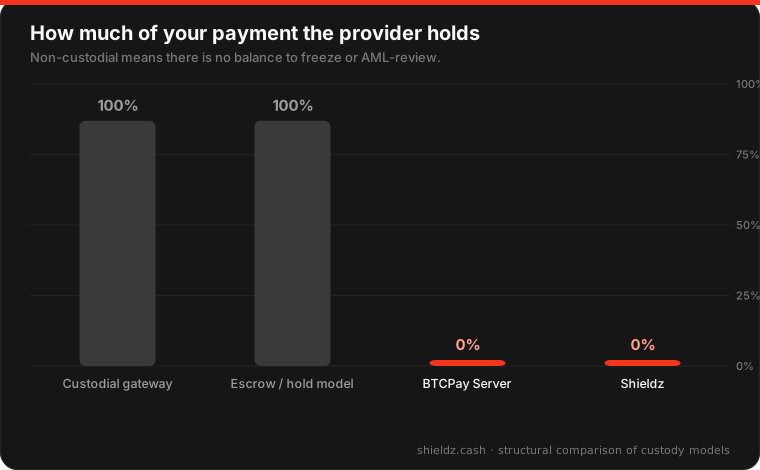
- They are custodial. The platform receives the donation into its own wallet and pays you out later, often taking a percentage. Because they hold the balance, they can freeze it, and a payout can stall for review, which is exactly the risk sensitive causes need to avoid.
- Transparent coins are not private. Bitcoin and Ethereum donations are visible to anyone forever. A “crypto donation button” for BTC or ETH gives your donor no privacy at all, no matter what the platform promises.
The non-custodial part: nobody can freeze the funds
A non-custodial crypto payment gateway never touches the donation. The donor pays, and the funds settle directly to a wallet your organization controls, on-chain, in the same transaction. There is no platform balance to freeze, no payout schedule, and no account to suspend. Shieldz works this way and you can verify it yourself: it only ever holds a public key, never your funds.
The privacy part: shielded Zcash
This is the piece almost no donation platform offers. In a shielded (z-to-z) Zcash transaction, the amount, the sender, and the receiver are all encrypted on-chain. The donation still confirms on the public blockchain, but the details are hidden. That is genuine on-chain donor privacy, not a promise from a company that can still see everything.
Shielded Zcash is the strongest privacy for a single coin. If you want donors to give in almost any coin and still break the on-chain link between donor and cause, private crypto payments use a confidential swap route to do exactly that.
So the combination that actually delivers “anonymous crypto donations” is: shielded Zcash for on-chain privacy, plus a non-custodial gateway so no company holds or logs the funds. Shieldz watches for shielded payments to your own Unified Address using a view-only key, so it can confirm a donation arrived but can never move it or reveal it.
How to set it up
- Get a Zcash wallet and its Unified Full Viewing Key (UFVK). A viewing key can see incoming donations but cannot spend them.
- Give the UFVK to Shieldz, or for other coins just paste a wallet address. No account or KYC is required to start.
- Create a donation link or a tip jar page in seconds, or a fixed-amount payment link. Share it anywhere.
- Donors pay shielded ZEC (or another coin) straight to your wallet. Shieldz confirms it and fires a signed webhook. The funds are already yours.
Ways to accept crypto donations, compared
| Option | Real donor privacy | Custody | Platform fee | KYC to start |
|---|---|---|---|---|
| Shieldz (shielded ZEC) | Yes (encrypted on-chain) | Non-custodial | $0 | No |
| Custodial donation platform | No | Custodial | Percentage cut | Usually yes |
| BTC / ETH donation button | No (fully public) | Depends | Varies | Varies |
An honest note on compliance
Privacy for your donors is legitimate, and it is not the same as evading the law. A few honest points: Shieldz screens paying addresses against the OFAC sanctions list, so donor privacy does not mean accepting sanctioned funds. Your organization still has its own tax, reporting, and record-keeping obligations, which do not go away because a rail is private. And complete anonymity is never absolute. What this setup gives you is strong on-chain privacy for the donor and full self-custody for the cause, which is the honest version of “anonymous crypto donations.”
FAQ
Can I really accept anonymous crypto donations? You can accept donations with strong on-chain donor privacy using shielded Zcash, settled non-custodially to your own wallet. The amount and parties are encrypted on-chain.
Is it custodial? No. Donations settle directly to a wallet your organization controls. Shieldz only ever holds a view-only key and can never move or freeze the funds.
Do I need KYC or an account? No KYC to start. Paste a Zcash viewing key or a wallet address and you are live, with a $0 platform fee.
Are Bitcoin donations anonymous? No. Bitcoin and Ethereum donations are public on-chain forever. For real donor privacy, use shielded Zcash.
Start accepting private donations
If your cause needs donors to give without being exposed, and needs the funds to stay in your own hands, a non-custodial gateway with shielded Zcash is the honest fix. Create a payment link or a tip jar in seconds, see how to accept Zcash, or read why a non-custodial gateway removes the freeze risk entirely.
