 shield
The Custody Gap: Only 1 in 4 Crypto Payment Gateways Is Non-Custodial
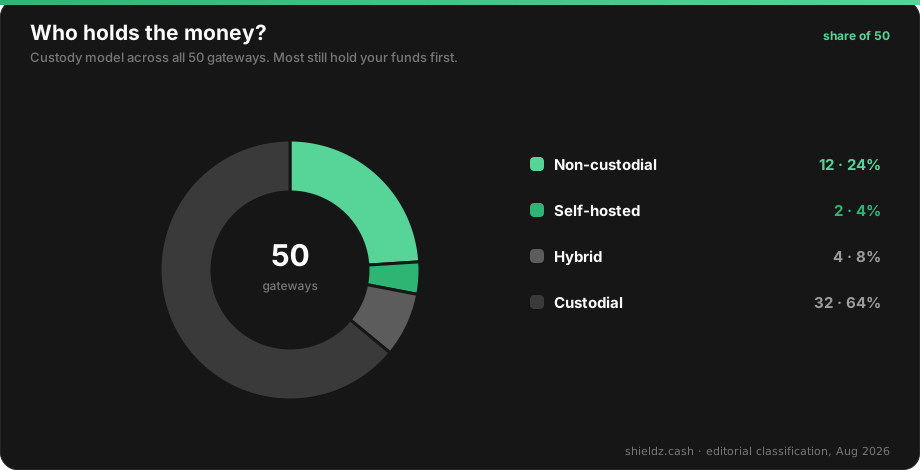
Shieldz Swap Swap now with shieldz.cash Any coin, any chain · 0.15% fee · no account Swap nowCrypto is supposed to mean “be your own bank.” For crypto payment gateways, it usually does not. In a August 2026 study of 50 crypto payment gateways, only 12, about 24%, are non-custodial. The other 64% are custodial: the provider’s wallet receives the buyer’s payment before the merchant does. Two are self-hosted software and four are hybrid.
This is the custody gap: a category of “crypto” products that reintroduce the exact intermediary crypto was built to remove.
Key finding: Only 24% of crypto payment gateways are non-custodial. 64% hold merchant funds before paying out. (Shieldz, Crypto Payment Gateways 2026, n=50.)
Why the custody gap matters
Custody is the single property from which every other gateway risk follows. Fund freezes, payout delays, account closures, withdrawal fees and forced KYC are all things that can only happen when a third party is holding your revenue. A custodial “crypto” gateway is, functionally, a bank account with fewer rights: the money lands in someone else’s wallet and reaches you on their schedule, under their terms.
The study found the pattern compounds. Of the 50 gateways, 58% require KYC before a merchant can accept a payment, and the providers that require it are overwhelmingly the custodial ones, because holding funds and touching fiat makes you a regulated money institution. Custody, KYC and payout control travel together.
The other numbers
From the same dataset of 50 crypto payment gateways (August 2026):
- 24% are non-custodial (12 of 50); 64% custodial, 4% self-hosted, 8% hybrid.
- 58% require KYC to start (29 of 50); 30% require none.
- The median platform fee is 1% per transaction; 10 of 50 advertise a $0 platform fee.
- 66% can settle to fiat (33 of 50), and fiat settlement is almost always custodial and KYC-gated.
Each of these has its own breakdown: custody, non-custodial count, fees, KYC, free gateways, and fiat settlement. The full provider-by-provider table is in the comparison of 50 crypto payment gateways (August 2026) or its update, the comparison of 87 crypto payment gateways (September 2026).
Methodology
We classified 50 crypto payment gateways by their published custody model, per-transaction fee, KYC requirement, coin coverage, fiat settlement and Lightning support, using provider pricing pages and documentation as of August 2026. Custody is an editorial classification based on each provider’s own docs: custodial means the provider’s wallet receives first; non-custodial means funds settle to an address the merchant controls; self-hosted means the merchant runs the software; hybrid depends on configuration. Seven fee figures could not be confirmed on an official page and are flagged in the data. The publisher, Shieldz, is a non-custodial gateway and appears in the dataset like every other provider.
Cite this report
- Stat: Only 24% of crypto payment gateways are non-custodial; 64% are custodial (n=50, August 2026).
- Source: Shieldz, Crypto Payment Gateways 2026.
- URL:
https://shieldz.cash/blog/custody-gap-crypto-payment-gateways - Dataset (CC BY 4.0, machine-readable): JSON · CSV · GitHub repository (updated monthly, with the full table as markdown and a
CITATION.cff). The published study covers 50 gateways; the dataset is a living resource, currently 86 providers.
The dataset is free to reuse with attribution. If you write about crypto payments, custody, or gateway fees, the numbers above are yours to cite.
The honest disclosure
Shieldz makes a non-custodial crypto payment gateway, so we have a stake in this framing. That is also why we published the raw data: you do not have to take the headline on faith. Download the dataset, check the custody column against each provider’s docs, and draw your own line. If you want to be in the non-custodial 24%, you can verify our own claim and start with a wallet address, no signup, no KYC, a $0 platform fee. For the full trade-off between the two models, not just the split, see custodial vs non-custodial crypto payment gateways.
