 shield
BitHide vs BTCPay Server (2026): Which Self-Hosted Crypto Setup Fits You?
Shieldz Swap Swap now with shieldz.cash Any coin, any chain · 0.15% fee · no account Swap nowBitHide vs BTCPay Server is a comparison between two self-hosted crypto payment setups that look alike on paper and are built for very different businesses. Both run on your own server, and with both, the keys and the funds stay with you. But BTCPay Server is free, open-source software that started with Bitcoin, while BitHide is a paid, closed-source business wallet built around stablecoins, compliance screening and mass payouts.
This guide lays the differences out side by side, using each project’s own pages as of 2026-10-28. We build Shieldz, a hosted non-custodial gateway, and mention it once at the end. For the wider self-hosted field (Bitcart, PayRam and DV.net too), see the best self-hosted crypto payment gateways.
The main differences at a glance
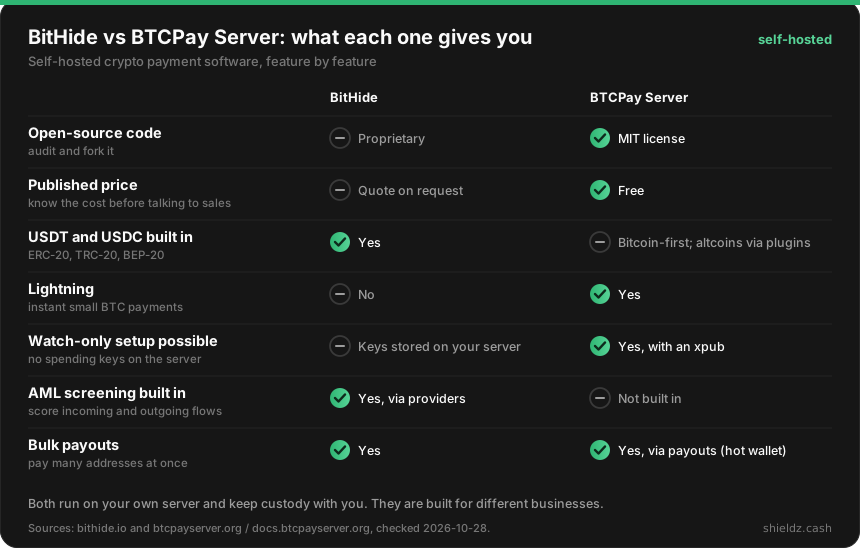
| BitHide | BTCPay Server | |
|---|---|---|
| What it is | Self-hosted business crypto wallet and payment gateway | Self-hosted payment processor |
| Source code | Proprietary | Open-source (MIT) |
| Price | Not published; contact sales for a quote | Free; you pay only for your server |
| Coins | BTC, ETH, LTC, TRX, BNB, plus USDT and USDC on ERC-20, TRC-20 and BEP-20 | Bitcoin and Lightning; altcoins via community plugins |
| Keys | Generated and stored on your server | Watch-only xpub possible; hot wallet optional |
| Compliance tooling | AML screening of incoming and outgoing flows through third-party providers | None built in |
| Payouts | Bulk payouts, double approval, role-based access | Payouts and pull payments (need a hot wallet or manual signing) |
| Extras | TRON energy optimization for cheaper USDT TRC-20 transfers, white-label edition for PSPs | Point of sale, crowdfunding, a large plugin ecosystem (WooCommerce and more) |
Price and source code
This is the sharpest difference. BTCPay Server costs nothing. It is MIT-licensed, about 7.9k stars on GitHub, and charges no processing fee; your only costs are the server and your time. Because the code is open, you can audit exactly what runs next to your wallet.
BitHide doesn’t publish a price. Its site asks you to contact the team for a custom setup, and independent reviews and software directories note the same: no public price, no free tier. It is proprietary software, so you trust the vendor’s build rather than code you can read. For a business that wants a supported product with a contract behind it, that can be a feature. For one that wants to depend on no vendor, it is a dealbreaker.
Coins: stablecoins versus Bitcoin
If your customers pay in USDT or USDC, BitHide fits better out of the box: Ethereum, Tron and BNB Chain stablecoins are first-class, and it adds a TRON “Energy” feature to cut the TRX cost of sending USDT on TRC-20. BTCPay Server is Bitcoin-first. Its strengths are on-chain BTC and Lightning, and other assets come through community plugins rather than the core.
If your customers pay in Bitcoin, especially small amounts, BTCPay is the stronger choice. It has Lightning built in, which BitHide doesn’t offer.
Key security: where the spending keys live
BitHide’s model is a business wallet: “private keys are generated and stored” on your server, which is what lets it automate bulk payouts and approvals. That keeps third parties out, but it means the server holds spendable funds, so a server compromise is a wallet compromise. Hardening, backups and access control are your job.
BTCPay Server can run watch-only. You give it an extended public key (xpub) from your hardware or desktop wallet, it derives a fresh address per invoice, and the server never holds a key that can spend. A breach can redirect future payments but can’t drain what you already received. You can add a hot wallet for payouts or Lightning when you need them. We explain the xpub model in depth in our self-hosted gateway guide.
Compliance and payouts
BitHide is built for businesses that move a lot of money out as well as in: payroll-style mass payouts, double approval for transactions, roles for staff, and AML screening through third-party providers to flag risky incoming funds. It has marketed itself to higher-risk industries where those tools matter. BTCPay Server has payouts and pull payments, and store-level user roles, but no built-in AML screening. If you need to score incoming transactions, you integrate that yourself.
Neither product does KYC for you, and neither is a licensed financial service; both are software you operate. Compliance with your local rules stays with your business.
Which one should you choose?
- Choose BTCPay Server if you take Bitcoin or Lightning, want open-source code and a $0 software cost, and prefer a watch-only server with keys on a hardware wallet.
- Choose BitHide if your flow is mostly USDT/USDC on Tron, Ethereum or BNB Chain, you need bulk payouts with approvals and AML screening, and you are fine paying for a closed-source product with vendor support.
If you wanted self-hosting mainly for the $0 fee and for keeping custody, and not because you want to run a server, a hosted non-custodial gateway is a third option. Shieldz charges a $0 platform fee, accepts stablecoins and 20+ coins, and settles every payment straight to your own wallet with no server and no KYC. You can verify that it never holds funds. It doesn’t do AML screening or mass payouts; if those are what you need, BitHide is the closer fit.
More head-to-heads: BTCPay Server vs CoinGate, PayRam vs BTCPay Server vs Shieldz and open-source crypto payment gateways compared.
FAQ
What is the main difference between BitHide and BTCPay Server? BTCPay Server is free, open-source and Bitcoin-first, with Lightning and a watch-only option. BitHide is paid, closed-source software built around stablecoins, AML screening and bulk payouts, with keys stored on your server. Both are self-hosted and non-custodial.
Is BitHide free? No. BitHide doesn’t publish prices; you request a quote from its team. BTCPay Server is free and open-source.
Does BTCPay Server support USDT? Not in the core. BTCPay Server is Bitcoin-first and adds other assets through community plugins. BitHide supports USDT and USDC on ERC-20, TRC-20 and BEP-20 out of the box.
Which is more secure, BitHide or BTCPay Server? They secure different things. BTCPay can run watch-only with an xpub, so the server can’t spend funds. BitHide stores keys on your server to automate payouts, and adds approvals, roles and AML screening. The safest choice depends on whether you need automated outgoing payments.
Is there a self-hosted-style option without running a server? Yes. A hosted non-custodial gateway like Shieldz settles payments directly to your own wallet at a $0 platform fee, so you keep custody without hosting anything.
